
Psychological Safety
Build a culture where people feel safe to speak up, take risks, and grow — together.
The job of fact-checking is all about establishing more certainty about what is true, engaging critical thinking and correcting false information. That often doesn’t leave much room for mistakes, nor for admitting weakness or vulnerability, at least not in public.
Against that backdrop, it can be a challenge for managers of fact-checking teams to create a culture of psychological safety. This is defined as a workplace culture where it is OK for employees to admit mistakes, ask questions, express vulnerability or suggest new ideas.
There is often confusion over what the term psychological safety means. It is sometimes thought of as a counterpoint to physical safety. When preparing for a dangerous or potentially disturbing assignment, journalists are encouraged to think about both physical safety and psychological safety (seen as synonymous with mental wellbeing).
The term has taken on a wider meaning in the context of team leadership due to research by Harvard professor Amy Edmondson that says that team members only engage in close collaboration when they feel “psychologically safe”, knowing that “questions are appreciated, ideas are welcome, and errors and failure are discussable”.
“People can focus on the work without being tied up in knots about what others might think of them. They know that being wrong won’t be a fatal blow to their reputation” – Amy Edmondson, Harvard Business Review
Do's and don'ts of psychological safety
- Be conscious of cultural differences:
The idea of psychological safety is very rooted in Anglo-Saxon organizational culture, where challenging authority is more acceptable than in other parts of the world. Employees from countries like Serbia, Nigeria and India that have a tradition of respect for hierarchy, might find it harder to express disagreement with their managers than colleagues from countries like the United Kingdom and the United States. Likewise, it might be easier for a manager in a flat-hierarchy start-up to admit fallibility than a boss in a large top-down traditional media house.
- Different generations may have different expectations:
- It’s not about being nice:
To be clear, psychological safety isn’t always about being nice and agreeing with everyone. This is not about creating environments where people think it is fine to slack off, or make mistakes without consequence. But if colleagues are afraid to speak up or experiment, organizations will miss out on open exchange, learning and innovation.
- Be aware of your conflict management style:
Successful teams need to be able to disagree and deal with conflict in a constructive way. So managers need to be alert to their own conflict management style if they want to promote good teamwork and be prepared to vary their style depending on the situation. Sometimes, it pays to be more assertive, while other times a more collaborative approach works better.

Research
During her research into drug errors in hospitals, Amy Edmondson came to the counterintuitive conclusion that better teams seem to make more mistakes, not fewer. She eventually realized that doctors and nurses in these high-performing teams don’t necessarily make more mistakes, but they report more because they don’t fear retribution for being open about problems. “My eureka moment was this: better teams probably don’t make more mistakes, but they are more able to discuss mistakes,” Edmondson said.
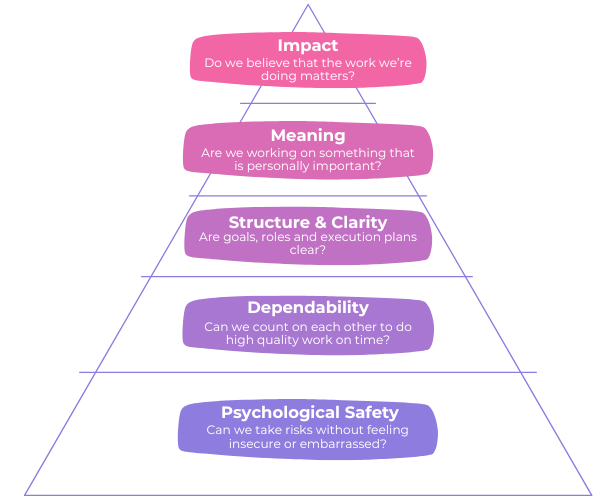
Google studied thousands of teams in “Project Aristotle” and concluded that the top-performing groups had five dynamics in common, with psychological safety the most important of them.
- DID YOU KNOW?
Boston Consulting Group (BCG) research shows that psychological safety is particularly effective at improving the workplace and reducing attrition for women, people of color, LGBTQ+ employees, people with disabilities, and people from economically disadvantaged backgrounds. The BCG data shows that members of diverse and disadvantaged employee groups say they are much more likely to quit when in workplace environments with low psychological safety as compared with their more advantaged peers in the same environment.
The other key factors cited by Google are:
One of the most powerful ways leaders can cultivate this culture is to practice active listening, which involves listening without judging or jumping to conclusions, and refraining from imposing your own opinions or solutions.
Journalists think they are good at listening, but usually we are trained to look for the key statement that fits into our story. In active listening, it’s important to connect, not to remember. There’s no hidden agenda, no feedback, we’re not trying to solve the other person’s problems. The goal is to connect from a deeper place with curiosity and empathy, not to gather information as we do when interviewing a source.

We often find it hard to resist the temptation to interrupt, while we usually jump in to fill any uncomfortable silence in a conversation. Here are some tips for how to practice active listening:
- Identify what kind of conversation you’re having: is it practical? Emotional? Social?
- Face the speaker and have eye contact. “Listen” to non-verbal cues too.
- Don’t interrupt. Encourage the other person to share what they have to say.
- Listen without judging, or jumping to conclusions, and try to avoid planning what to say next.
- Show that you’re listening by acknowledging how the other person is feeling and looping back what you’ve heard for accuracy.
- Share how you feel, and avoid imposing your opinions or solutions.
- Tips for individuals
A culture of psychological safety is often the responsibility of team and organizational leaders, who help set the tone of interactions amongst team members. That said, individuals have a number of tools at their disposal for encouraging psychological safety in a team.
- Model psychological safety with peers, to show what it looks like in practice, including asking each other regularly how they’re doing.
- Practice upward management and internal advocacy.
- Learn communication skills such as assertiveness.
- Practice ostentatious listening: members of a team demonstrate they are actively listening by repeating what has just been said and making eye contact (a bonus – this kind of amplification of colleagues can help fight gender bias).
- Identify opportunities to engage in active listening with audience and clients.
- Practice active listening: If managers can master the technique, they often find it liberating as they no longer feel under pressure to fix everyone’s problems. Often, a team member who feels truly heard will feel supported to come up with their own solution.
- Model vulnerability: Show your own humanity and humility as a leader. This can be uncomfortable at first so Dan Cable, professor of organizational behavior at London Business School, has this advice: “When we are feeling vulnerable, we need to talk to ourselves and others with phrases like, “The brain is a muscle that gets stronger with practice,” and “Nobody ever walked before they fell.”
- Admit your own ignorance: Celebrate mistakes as learning opportunities rather than shaming people who are brave enough to say they don’t know.
- Make space for everyone to speak: To encourage sharing, you can implement a rule in meetings that no one talks twice before everyone has a chance to talk once. (This can also help value the different backgrounds, experiences, skills, personalities, and styles that each person brings to the table.)
- Offer feedback, celebrate success: Give as much praise as criticism.
- Hold regular one-to-one meetings.
- Proactively address disagreements: Address problems before they spiral out of control and acknowledge that every conflict has two sides and you might carry responsibility too.
- Encourage feedback of your leadership: This can be a nerve wracking experience at first, but transparent feedback can help you improve as a leader. Try to react with openness and listening.
- Make sure you communicate your own boundaries: Active listening and creating these kinds of spaces with your team demands energy and you can’t be available at all hours.
- Tips for managers
Promoting psychological safety often demands a big shift in organizational culture. If a manager wants to encourage team members to admit to mistakes or suggest new ideas, they will need to acknowledge their own fallibility and be open to constructive criticism of their own leadership.
Here are some ways that a leader can promote a feeling of safety in a team. These tips can be applied in team meetings or one-to-one meetings:
- Mental Health in Action


- Additional Resources
This article by Samantha Ragland, Vice President of Journalism Programs at the American Press Institute, includes a downloadable worksheet to assess where you fall across the five dynamics of effective teams.
Mar Cabra, the co-founder and executive director of The Self-Investigation, writes on the importance of deep conversations.
Charles Duhigg, a Pulitzer Prize–winning journalist and author, speaks on four rules for a meaningful conversation, when to be vulnerable, and how to form the habits of becoming a “supercommunicator.”
The company has conducted and released research on psychological safety in a variety of ways. Check out Project Aristotle, explained in this NY Times article “What Google Learned From Its Quest to Build the Perfect Team”. Their re:Work page on “Understand team effectiveness” includes resources such as the Team Effectiveness Discussion Guide and a Guide on “How to foster Psychological Safety on your teams”. Finally, “Team dynamics: Five keys to building effective teams”, includes “7 questions to help gauge the level of psychological safety in your team.”
This research shows how fostering psychological safety has to begin with the most senior leaders embodying the leadership behaviors they want to see across the organization, and the need for investing in leadership development programs to equip leaders to do that.
This article focused on avoiding blame culture, promoting diversity and letting teams make mistakes.
Tips on how leaders can model vulnerability, invite participation and other advice to promote better teamwork.
Amy Edmondson's work
An article on the importance of failure for learning.
An engaging video covering key frameworks like the Learning Zone and acknowledging your own fallibility as a manager.
One of Edmonson’s first key papers on the topic, based on a study of 51 work teams.
This book offers a step-by-step framework for establishing psychological safety on team, along with illustrated scenarios and practical guides.
- The Self-Investigation Academy
Videos from the Mental Health in Journalism Summit:
- How to Ask “Are You Okay?” Without Being Afraid of the Answer by Ute Korinth
- Building Resilience: How Journalism Organizations and News Leaders are Supporting Mental Health by Samantha Ragland, Ute Korinth, Michael Sanserino, Katy Katopodis and moderated by Dr. Kortni Alston Lemon
- Mental Health as a Collective: The Newsroom as the First Place of Support by Laura Aguirre
- Psychosocial Safety in Broadcasting: Why a Compassionate Perspective Leads to Better Journalism by Julie Freeborn and Peter Kinderman
Credits
This guide was developed collaboratively by The SelfInvestigation team, based on trainings led by Kim Brice and Aldara Martitegui. The Mental Health Leadership Toolkit for Fact-Checkers was developed with generous support from the International Fact-Checking Network.
Authors: Emma Thommason
Contributor: Natalia Martín Cantero
Spanish Translation: Natalia Martín Cantero
Editors: A.X. Mina, Mar Cabra
Design: Paula Montañà Tor, Mariam Mamdouh
Illustrations: Diana Cuéllar